

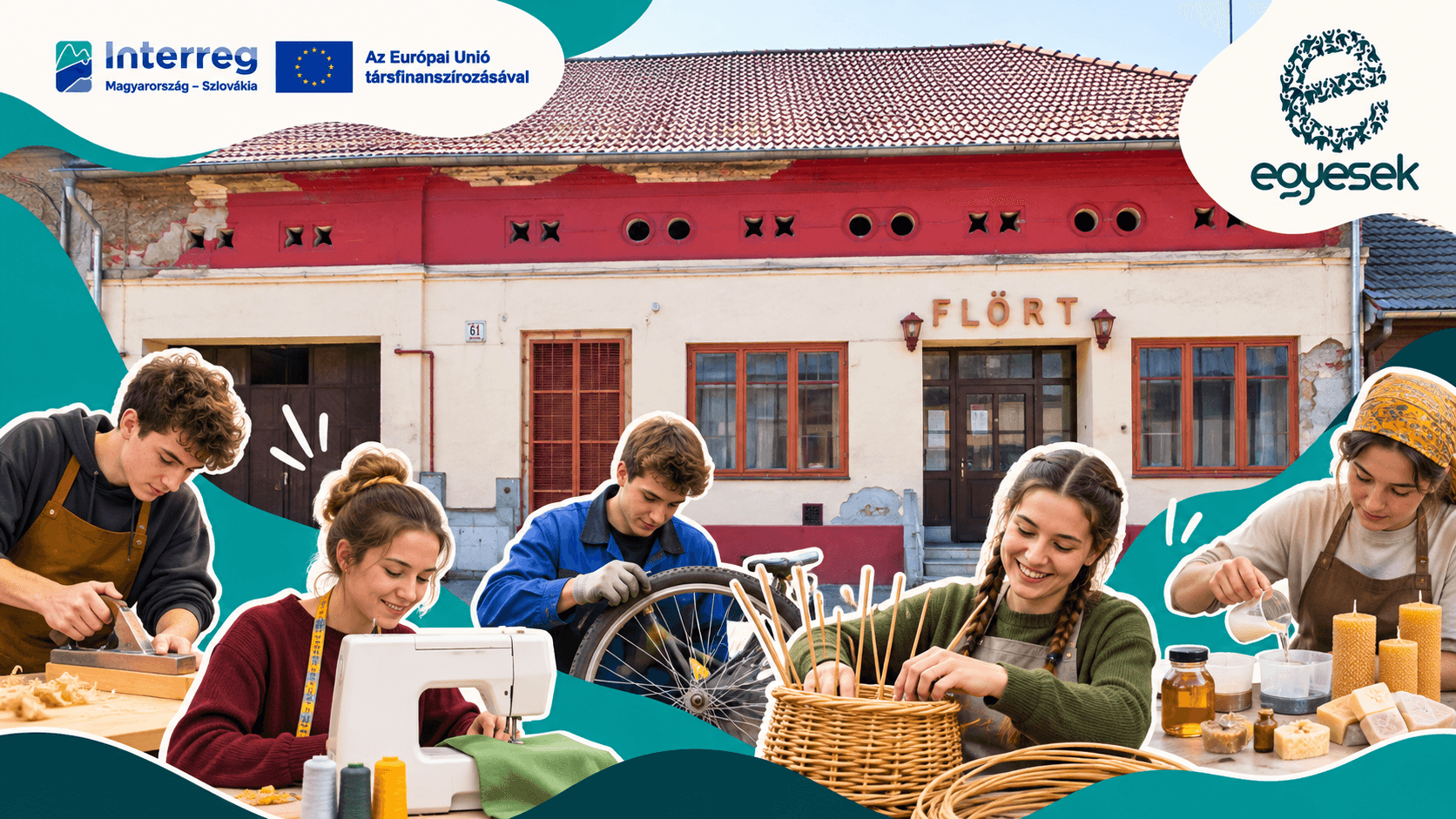
How can a traditional craft become a starting point for learning, gaining independence and even launching a business for young people? This is the question explored by SkillRoots, a joint Interreg project led by Egyesek and its Slovak partner, VOX terra.
Knowledge worth passing on
Just think about it: how many crafts, techniques and practical skills exist around us that fewer and fewer people know today? How many local craftspeople have decades of experience they would gladly pass on, but have fewer and fewer opportunities to do so? And at the same time, how many young people are still searching for their place in the world, eager to learn something useful, create, and try their hand at something new, but struggling to find the right path?
The SkillRoots project aims to address both of these challenges. We believe that traditional and contemporary crafts represent more than just cultural value. They offer practical knowledge that can still be used today to create valuable products, provide services and even build a livelihood. To make this possible, however, we need to connect this knowledge with people who are looking for new opportunities.
Opportunities for young people who are still finding their way
One of the project's key target groups is young people who are currently not in employment, education or training. In international terminology, they are referred to as NEET young people (Not in Education, Employment or Training). Many of them may not find their opportunities through traditional educational or employment pathways. For them, learning formats that provide tangible results, a sense of personal achievement and real hands-on experience can be particularly valuable.
That is why SkillRoots takes a hands-on approach to learning. Participants will have the opportunity to explore different crafts, learn basic techniques and create their own products. But the process does not stop at making things: young people will also receive support in learning how to turn an idea into a product that can be sold, calculate production costs, set prices, present products to customers and potentially start a small business.
The aim is not to turn everyone into an entrepreneur. Rather, it is to help young people gain skills, experience and confidence that will give them more opportunities to shape their own futures.
What can we learn from each other? Generations coming together in the workshop
Another important pillar of SkillRoots is intergenerational knowledge transfer. Many traditional crafts are learned through personal experience, practice and time spent alongside skilled craftspeople. Not every technique can be learned from a book: you need to see someone at work, try it yourself, make mistakes and try again. That is why we aim to work with experienced craftspeople and professionals who can pass on their knowledge to younger generations.
This exchange can be valuable for both sides. For experienced craftspeople, it creates an opportunity to keep their knowledge alive, while young people can meet role models and mentors from whom they can learn not only a craft, but also an approach to work, perseverance and a creative mindset. In this way, tradition and innovation do not have to be opposites – they can strengthen each other.
Making something is not enough – it also needs to have value
One of the project's key questions is which handmade products can find a genuine market today.
In today's world, almost anything can be ordered with just a few clicks. Competing with cheap mass-produced goods is difficult, and that is not our goal. Instead, we want to explore products and crafts that offer genuine value: products that are high-quality, durable, unique, based on local knowledge or have special added value that customers are willing to pay more for. To identify these opportunities, we need the experience of craftspeople, as well as the opinions of customers and local communities.
That is why market-oriented thinking will play an important role alongside craft skills in the project. Young people need to understand that making a good product is only the first step. They also need to know who the product is for, what problem or need it addresses, how much it costs to produce and how to reach potential customers. This is how creative craftwork can be connected with the development of entrepreneurial skills.
Cooperation across the Hungarian–Slovak border
SkillRoots is supported by the Interreg VI-A Hungary-Slovakia Programme, with Egyesek Youth Association as the lead partner and VOX terra o.z. from Slovakia as its project partner. Cross-border cooperation matters for more than just geographical proximity. Both countries have local communities, craftspeople, craft traditions and social challenges that offer valuable opportunities for shared learning.
Together, we are developing a methodology that connects intergenerational learning, craft training, skills development for young people and entrepreneurial knowledge. The joint work will also include staff exchanges, the alignment of training methods and the organisation of a joint cross-border Craft Camp. The camp will provide an opportunity for participants, craftspeople and professionals to meet in person, share their experiences and present the results achieved during the project.
The knowledge and experience gained will be brought together in the SkillRoots Toolkit, available in both Hungarian and Slovak, so that the methods and learning materials developed during the project can also benefit other organisations and communities.
A workshop where new paths can take shape
In Hungary, one of the project's key locations is Szécsény, where we also aim to support the initiative by setting up a community workshop in our youth community space. We imagine this workshop as much more than a place for organised activities. It will be a space where young people can try their hand at new things, explore different tools and techniques, create together and gradually bring their own ideas to life.
Our long-term goal is to ensure that the knowledge, connections and methods developed during the project remain available to the local community after the project ends. The community workshop, the relationships built with local craftspeople and the network of cooperating organisations can all help ensure that these opportunities remain accessible to young people in the future.
Knowledge lives on when we pass it on
For us, SkillRoots is about preserving traditions while creating opportunities for the future. We believe that traditional crafts have a place in today's world, and that practical knowledge, personal connections and the joy of creating can play an important role in helping young people become more independent. To make this happen, however, we need the support of local communities.
We are looking for craftspeople, skilled professionals, makers and entrepreneurs who would be happy to share their knowledge, take part in workshops or contribute their ideas to the project. We would also love to hear from anyone who believes that certain handmade products or crafts have a promising future. If you know someone we should connect with, or have an idea you would like to share, get in touch with us!
About the project
- Project title: SkillRoots – Cross-Border Intergenerational Craft & Youth Entrepreneurship
- Project ID: HUSK/2501/2.1/100
- Project duration: 1 January 2027 – 31 December 2028
- Lead partner: Egyesek Youth Association (Hungary)
- Project partner: VOX terra o.z. (Slovakia)
- Project area: The Szécsény micro-region in Hungary, and the following districts in Slovakia: Brezno, Krupina, Veľký Krtíš, Banská Bystrica, Levice, Lučenec and Rimavská Sobota.
- Total project budget: EUR 383,460
- Maximum support from the European Regional Development Fund (ERDF): EUR 306,768 (80%)
- Funding programme: Interreg VI-A Hungary-Slovakia Programme
Building partnerships!

The project is co-financed by the European Union through the Interreg VI-A Hungary-Slovakia Programme.
