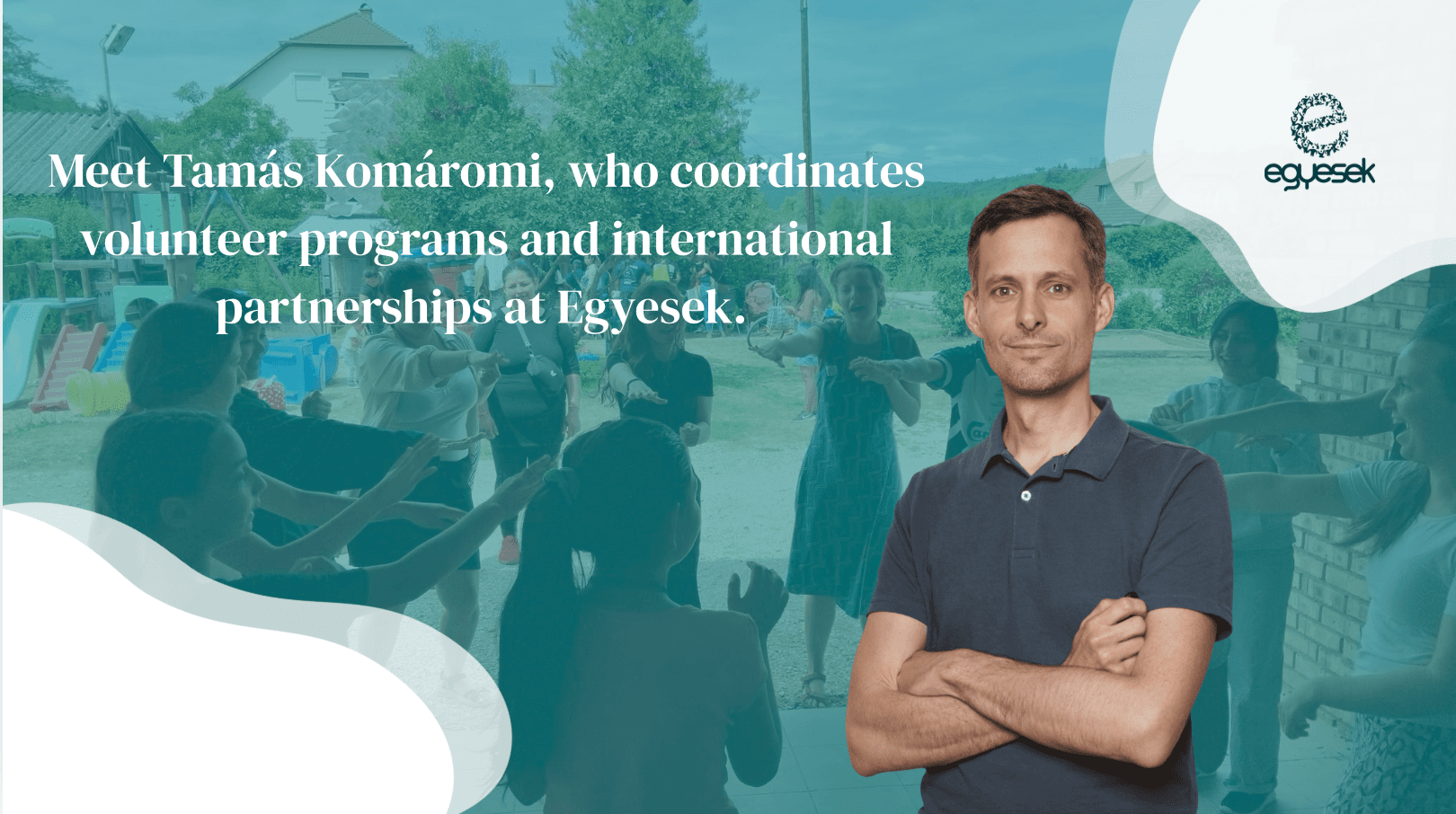
Tamás Komáromi has been a valuable member of the Egyesek team since 2022, and has since become a key contributor to volunteer programs, international cooperation, and organizational development processes. His work is highly diverse: he coordinates international volunteer camps, supports young people participating in volunteering programs abroad, prepares mentors, writes grant applications, and actively contributes to the strategic development of the organization. Today, he brings his experience from both the multinational corporate and civil sectors into the Egyesek community, working every day to ensure that more young people can experience the true power of volunteering. We spoke with him about motivation, learning, communities, and what volunteering can offer young people today.
How did you find Egyesek, and what background did you bring to the organization?
I joined Egyesek in April 2022, during quite a dynamic period. At the time, many changes were happening within the team: responsibilities were shifting, new roles were emerging, and rebuilding after COVID brought many challenges. There were around six of us in the team, and one of the most experienced colleagues had just left for a six-month sabbatical. As a result, I quickly took over the coordination of sending volunteers abroad, and soon many different responsibilities came my way.
Before joining Egyesek, I spent sixteen years working as a trainer and organizational development consultant at multinational companies. I worked in process development, systems improvement, and training, so I arrived with a strong professional background. Before Egyesek, I also worked at a civil organization supporting knowledge exchange between Balkan countries in the field of child protection.At the same time, I had already been volunteering for years at one of InDaHouse Hungary’s learning centers in Borsod. That experience was deeply meaningful for me, both in terms of community and values. That was where I truly understood the power of giving your time and attention to support others.When a three-year project ended at my previous workplace, I knew I no longer wanted to work internationally but rather on a domestic level. That was when I came across Egyesek’s job posting. I originally applied for a leadership position, but another professional was ultimately selected. Still, the team decided they would be happy to have me join, even though my exact role was not yet fully defined.By then, I had already heard many positive things about Egyesek, though I did not know their field of work in depth. When I was younger, I missed out on the world of Erasmus+ youth programs and international volunteering. Still, I immediately felt the immense value of these programs and wanted as many young people as possible to experience them.
What programs are part of your work today?
My work is extremely diverse, but the main focus is organizing international volunteer camps and supporting volunteers. Currently, Egyesek is the only Hungarian civil organization that regularly organizes workcamps, meaning international volunteer camps. These are programs where volunteers of all ages come from different parts of the world to join the life of a local community or civil organization and support their work. In return, they receive accommodation and meals during the program.
We also organize group volunteering programs supported by the ESC (European Solidarity Corps). These are similar to workcamps in both content and experience, but here young people aged 18–30 receive travel support and pocket money.
Because of my experience with learning centers, summer camps for children are especially close to my heart. We work with many learning centers to help disadvantaged children gain broader perspectives. If they cannot travel themselves, at least a group of young people from abroad can come to them, bringing culture, new perspectives, and inspiration. On the other side, I also support Hungarian young people in participating in volunteering programs abroad. Last year, I helped 81 young people join short-term volunteer programs and 15 join long-term individual volunteering programs lasting 6–12 months.I am also involved in youth work in Szécsény: I recruit and prepare mentors and facilitate monthly group mentoring sessions for the volunteers who come to us.In addition, I write grant applications, seek new funding sources, contribute to strategic development, support HR processes, mentor interns, deliver trainings, and build partnerships. At Egyesek, almost every day brings something new.
Why is international volunteering so close to your heart?
Because it serves a meaningful cause while also giving young people life-changing experiences.Through volunteering, participants gain a much deeper understanding of themselves. They develop practical skills, improve their collaboration, communication, and problem-solving abilities. But even more importantly, their sense of solidarity grows stronger.A tourist travels somewhere, visits landmarks, and goes home. A volunteer, on the other hand, truly becomes part of a community’s life. They do not observe from the outside—they connect, contribute, and think together with others. That is a huge difference.
What is your role in supporting volunteers?
I see myself primarily as a supporter. It is important to me that I help them in the ways they actually need support. I explain the key frameworks and provide essential information, but from that point onward, they are responsible for shaping their own experience. I believe this is a fundamental youth work methodology. I do not want to solve life for them, and I do not want to control them. If they make mistakes, they learn from them. If they get stuck, I am there to help—but the decisions are theirs. This matters because it is what transforms an experience into real learning. This is how the lessons become integrated into a young person’s life.
What challenges do you encounter most often?
Unfortunately, quite a few.Hungarian culture, for example, does not strongly encourage volunteering. Many young people hear things like: “Why would you go abroad to volunteer? You should study or work instead.” Financial difficulties are also a serious barrier.Hosting organizations also face challenges. You cannot simply send a group of young people somewhere and expect everything to work. They need preparation, coordination, and support. And of course, Hungary is not among the most attractive destinations in international volunteering. The language, the country’s reputation, and cultural distance can all create challenges.
What would you say to young people who are still thinking about volunteering?
You are young now.Your friends, your family, and your job will most likely still be here tomorrow. But adventure will not wait forever. Volunteering may become one of the most defining experiences of your life. You will meet people you would never otherwise encounter, face situations that challenge and develop you, and collect stories you will still be telling many years from now.
Tamás’s story shows that volunteering is much more than helping others. It is a process of learning and connection that shapes individuals, communities, and society as a whole. Every young person who chooses to take part in this experience not only develops themselves but also contributes to building a more open, cooperative world.