
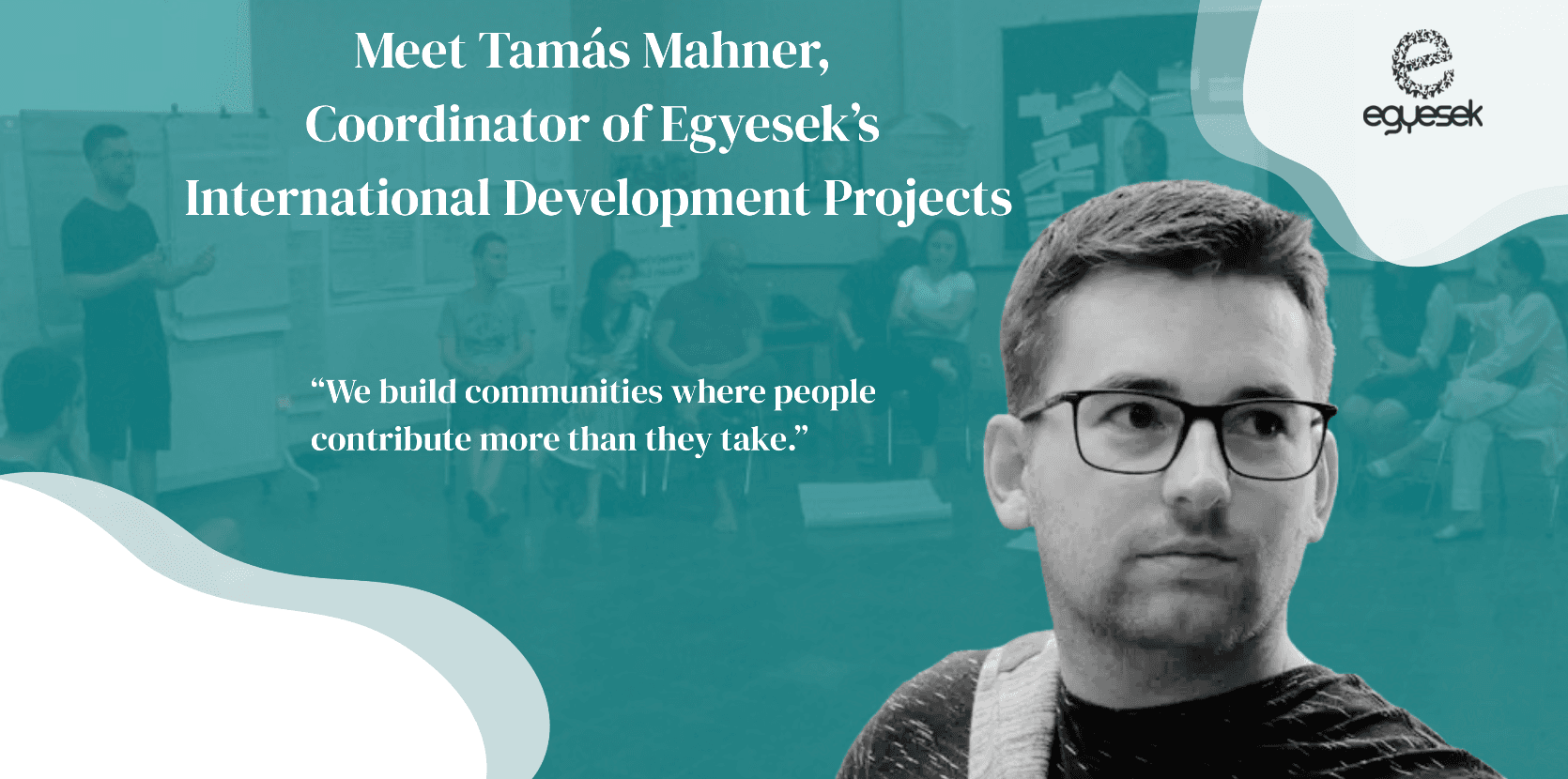
Tamás Mahner has been a key figure in the international work of Egyesek for more than fifteen years. From sending volunteers abroad to hosting international participants and coordinating large-scale development projects, he has worked across many areas of the organization. We spoke with him about how these international collaborations are built, why local communities are essential, and what long-term impact this work can have on young people’s futures.
How did you become involved in Egyesek’s international work, and how did your current role evolve?
I first started working at Egyesek by coordinating the sending of volunteers abroad, and later I took over the coordination of hosting volunteers as well. Over time, we expanded this work to Nógrád too. Not long after that, we organized Egyesek’s first international volunteer camp, which became an important milestone in the organization’s history.Over the years, I worked on many EVS (European Voluntary Service) projects and IVS (International Voluntary Service) camps, which allowed me to build continuous relationships with international partner organizations. Many of these partners are members of major networks such as CCIVS (Coordinating Committee for International Voluntary Service) and the Alliance of European Voluntary Service Organisations. At one point, it felt like a natural step for us to join these networks ourselves. Since then, we have become active members of both, and this has brought tremendous professional value to our work.I basically grew up in this environment. From the very beginning, I have been working with these partners, so international cooperation has never felt like a separate field to me—it is simply a natural part of how Egyesek operates.
What international projects are you currently working on, and why are they important?
At the moment, I coordinate the Power to the Sending Organisations project on behalf of Egyesek. This is a strategic development project focused on strengthening the role of sending organizations.Over the years, we have seen how the Youth in Action programme, and later Erasmus+, gradually reduced support for sending organizations. This is a serious issue because sending organizations play a crucial role in preparing volunteers before they go abroad. When this preparation is weak or incomplete, it affects the volunteer experience and ultimately the quality of the project itself.In this project, we are developing different preparation modules to help organizations provide meaningful, high-quality support for young people before they leave. If the foundations are strong from the beginning, that has a positive impact on every later stage of the process.
How do you see the differences between various international project formats?
Each project type has its own role in youth work. Volunteer projects connect young people directly with local communities. Training courses create opportunities to transfer practical knowledge from the field to other youth professionals. Long-term strategic projects, meanwhile, can create major leaps in quality and innovation that influence organizations or even entire professional networks for years.For me, however, international volunteer camps remain the closest to my heart. I strongly believe that any organization calling itself a youth organization should have activities that directly support local communities, while actively involving those communities in the process.Healthy societies cannot exist without communities. That is why strengthening local communities is one of the most important goals of our work. Once this foundation exists, every other type of project can be built on it in a credible and meaningful way.
What makes Egyesek unique in the international field?
What we do at Egyesek is, in my view, quite unique. We do not focus on only one segment of youth work—we cover the full spectrum.We have our own community spaces where local staff work directly with local people. We have our own training center where we educate young people and youth professionals. At the same time, we actively participate in leading international networks and implement long-term strategic projects.This matters because every level builds on the others. Our local experience gives us credibility internationally, while our international experience continuously strengthens our local work.
What challenges come with international cooperation?
One of the biggest challenges is that more and more organizations are emerging that mainly focus on coordination but do not actually carry out meaningful youth work on the ground.I find this problematic because I believe an organization can only be a credible partner if it has direct experience with the community or target group it serves. If an organization only acts as an intermediary without a real connection to field realities, it weakens project quality in the long run.The other major challenge is constant change. People come and go within partner organizations, priorities shift, and new problems emerge. You have to adapt continuously while ensuring that the quality of the project does not suffer.
What impact do these projects have on young people?
It is difficult to measure precisely, but based on feedback, we see that participants become more confident and more independent.They gain a deeper understanding of themselves, develop a clearer sense of direction, and find it easier to make decisions about their future. For me, this is one of the most important outcomes. The key is helping people engage in activities they genuinely enjoy. When someone is in a good place internally, it becomes much easier for them to contribute to their environment and community. In essence, we build communities where people give more than they take.
What does this work give you personally?
For me, one of the greatest values of international development work is mutual learning.This is one of the most effective ways to share the experience and knowledge accumulated at Egyesek beyond national borders. At the same time, this is never a one-way process—we also learn a great deal from our partners. This constant exchange of knowledge is what keeps this work inspiring for me, even after so many years. Tamás’s story shows that international youth work is not simply about mobility opportunities or project implementation. At its core, it is about connection, community building, and a continuous learning process that shapes participants, organizations, and local communities alike. For Egyesek, this is what gives international work its true meaning.
